

Breadcrumb
Pacific earns gold recognition for Exercise is Medicine
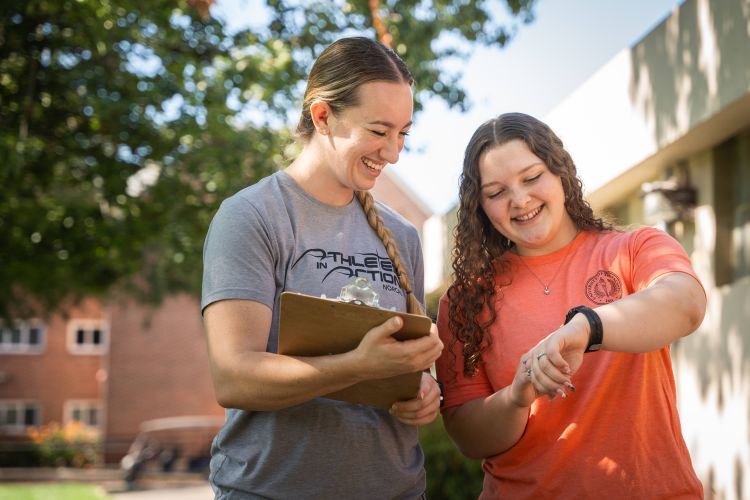
As part of the Exercise is Medicine initiative, the WE-Fit peer-to-peer program connects student coaches with fellow students to track their physical activity and work toward their fitness goals.
At University of the Pacific, getting your steps in isn’t just considered good for you, it’s part of campus culture. Now, that culture is earning national recognition.
The university has received GOLD-level status for its Exercise is Medicine program, an initiative of the American College of Sports Medicine that encourages colleges and universities to make physical activity a visible and essential part of campus health and wellness. Pacific is one of 94 universities worldwide to receive a gold designation.
The recognition reflects Pacific’s growing network of fitness programs, student involvement, research and community partnerships designed to get students and employees moving while preparing future health professionals to utilize exercise as part of whole-person care.
Alexis King ’15, ’17, assistant professor of health and exercise sciences, launched Pacific’s Exercise is Medicine initiative in 2023 after seeing how the program could unite students and campus partners around a shared focus on health.
“We know that exercise is linked to increased longevity, quality of life, improved mental health and reduction in stress,” King said. “So we’re trying to instill that framework within our students in young adulthood.”
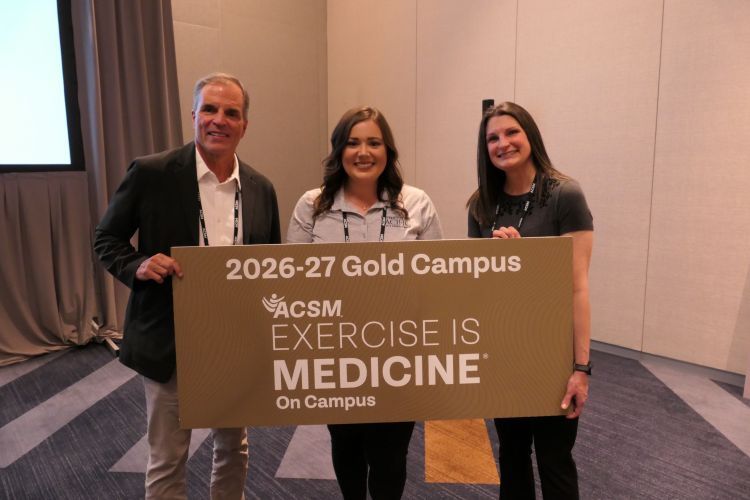
Assistant professor Alexis King, center, accepts the Gold Campus Award alongside Exercise is Medicine founder Dr. Robert Sallis and Exercise is Medicine Board Chair Lisa Leininger at the American College of Sports Medicine conference in May 2026 in Salt Lake City, Utah.
Some of the popular initiatives that helped Pacific earn the recognition include:
Fitness and wellness events
Throughout the year, Exercise is Medicine hosts activities such as yoga on the lawn and brings health and wellness experts to campus to engage with students.
Next month, through Pacific’s partnership with the San Francisco 49ers, Professor Ianzou Zhang will welcome Jordan Mazur, the 49ers’ director of performance nutrition, to speak with students about nutrition strategies for football athletes and how nutrition can be used as a tool to enhance overall wellness among college students.
Five Steps to Fitness
Pacific students, faculty and staff can also participate in Five Steps to Fitness, a free assessment that gives participants a snapshot of their physical health. The program measures aerobic capacity, muscle strength and flexibility and provides participants with a Fit3D body scan to assess body composition.
Passport to Play
Through a partnership with Pacific Recreation, Exercise is Medicine hosts a 31-day challenge where participants complete activities on a BINGO card throughout the month and are entered into a raffle to win prizes.
WE-Fit
WE-Fit is an eight-week peer-to-peer program in which trained student coaches work with fellow students on physical activity and wellness goals. Participants track steps and and complete measures such as body composition and blood pressure, while also discussing their goals and the barriers that can make staying active difficult. Because the program is led by students, participants get support from peers who understand the demands of college life.
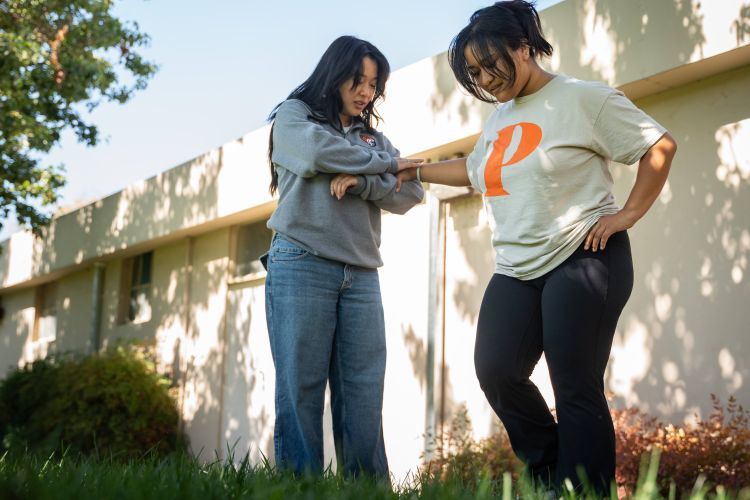
Students perform heel-drop stretches before setting out on a walk.
Jordan Mabutas ’28, a graduate student in Pacific’s Health and Exercise Science program, joined WE-Fit as an undergraduate because she wanted to learn more about exercise and research.
“The program helped those who wanted to stay fit during their time in college, but didn't know how to properly manage their time,” Mabutas said. “Students in the program did better in a group workout setting with other peers around them. Motivation and encouragement were both huge factors that played a big part in student involvement with Exercise is Medicine and WE-Fit.”
Sylvia Valverde ’27, the current Exercise is Medicine club president, views the program as a way to advocate for students.
“My favorite part about being involved with Exercise is Medicine is collaborating with other peers to make positive impacts for the student body,” she said. “As students, we tend to lose consciousness of our physical and mental needs in the midst of academic and other responsibilities. Exercise is Medicine is here to help students de-stress and take time for themselves to support their health.”
The initiative also reaches beyond Pacific’s campus. Through a partnership with Dignity Health St. Joseph's Medical Center, students work with patients in the hospital’s cardiac rehabilitation and cancer exercise programs, treating patients who are recovering from cancer treatment and managing chronic conditions with exercise.
The partnership offers Pacific students a firsthand look at what it means to put holistic health into practice, and it points toward a potentially broader role for the program as Pacific prepares to open its School of Medicine in 2030 with Dignity as the official clinical health partner.
King hopes Pacific students pursuing careers in health care will learn to view exercise as a formal part of a patient’s treatment plan.
“It should be prescribed just like it is in terms of a pharmaceutical medicine,” she said.
Patients are often told to exercise more but may leave the doctor’s office unsure of what that actually means.
“Patients will say, ‘Well, my doctor tells me to exercise more,’ and we say, ‘Okay, that’s great. What do they want you to do?’” King said. “The patient doesn’t even know where to begin.”
As Pacific expands its health care education programs, Exercise is Medicine can help give future clinicians opportunities to see how movement, prevention and rehabilitation fit into patient care.
“A lot of medical schools are starting to incorporate exercise into the curriculum,” King said. “That’s exactly what we’re trying to advocate for—that future clinician who is going to diagnose patients, but is also going to treat the whole person.”