

Breadcrumb
Raymond College alumni honor fleeting lifetimes, enduring legacies
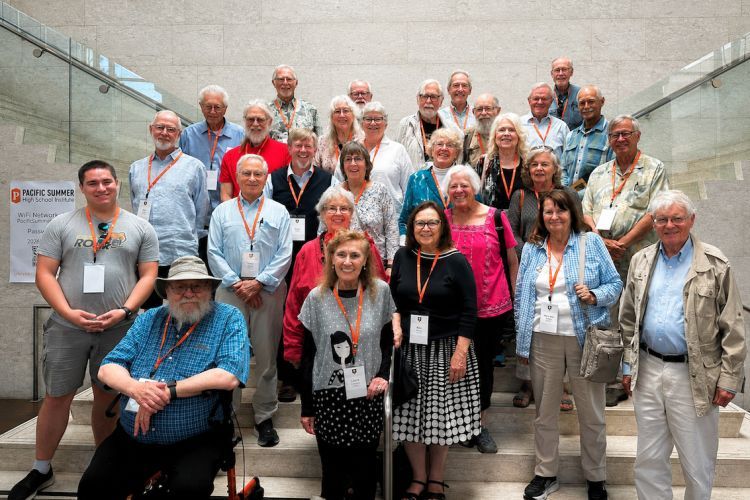
Raymond College alumni from the college’s first five years, the classes of 1965-69, returned to campus in June.
In early June, dozens of alumni converged on University of the Pacific’s Stockton Campus. They rekindled friendships, shared life stories and exchanged practical wisdom with the same intensity they brought to the classroom six decades ago.
The reunioners attended Raymond College, one of three “cluster colleges” at Pacific during the 1960s and ’70s. The group comprised alumni from Raymond’s first five years—the Classes of 1965-69. Though Raymond no longer operates today, its alumni have sustained its legacy through their intellectual, physical and philanthropic contributions.
"Raymond alumni are remarkable, in both their achievements and their impact at Pacific. Their accomplishments and engagement exemplify our hopes for all our graduates,” said Vice President for Development and Alumni Relations Scott Biedermann ’05, ’20.
Raymond was the first of three cluster colleges—smaller schools within the larger university structure—formed by Pacific’s 18th president, Robert E. Burns ’31, who sought to keep Pacific competitive with California’s rapidly growing public universities while preserving its liberal arts heritage.
Raymond College operated on the Stockton Campus from 1962-79. Recognized for their exceptional academic talent, students lived in community with their peers and faculty and completed a rigorous, accelerated curriculum emphasizing cultural immersion, which included weekly formal dinners with faculty and distinguished guests.
Today, Raymond alumni worldwide boast impressive career achievements in academia, public service, research and more.
“I’m thankful for my Raymond education because I learned how to think critically,” said Laurel Koepernik ’69. “I’ve always been told that I thought differently than other people—I can summarize things and think outside the box—and I know that came from Raymond.”
Koepernik serves with Doug Haner ’65 and five others on the Raymond reunion planning committee. Their annual gatherings began in 2023, when two of Haner’s classmates were in failing health and their friends wanted to share a last visit.
“We called it a pop-up reunion, because it was done pretty spontaneously—it took us a couple of months to get all the arrangements made, and it was a wonderful event,” Haner said.
While subsequent reunions have varied in size and scope, they consistently capture the spirit of Raymond, with storytelling prompts and opportunities to exchange personal and professional expertise. Social time also is abundant.
“As we age, we’re all realizing the importance of having close friends around us, especially old-time friends to reconnect with,” Haner said, noting that most Raymond alumni today are in their 70s and early 80s. “We’re so appreciative of how the university has supported our efforts to continue meeting—that support keeps us going.”
Several alumni have taken their engagement with Pacific one step further through generous philanthropic contributions. A few have included the university in their estate plans.
Jim Ratcliff ’67 sees his gifts as a means of sustaining Raymond’s legacy at Pacific, preserving the facets of a liberal arts experience that are unique and enduring over time. In 2021, Ratcliff established the Raymond College Alumni Endowed Scholarship, supporting humanities majors in the College of the Pacific.
“To me, a liberal arts education represents a rite of passage from being a teen to becoming an adult. It’s an important time in someone’s life—this scholarship recognizes that, and its name ties the Raymond College legacy to the bigger legacy of Pacific,” he said.
Since its inception, dozens of Raymond alumni—including many of the 2026 reunion attendees—have contributed to the scholarship.
"We are grateful to the many alumni and friends who’ve supported this scholarship. Their gifts allow our students to carry forward the Raymond legacy, overcome financial obstacles and make their own meaningful contributions to the world,” said Vice President Biedermann.
Ratcliff also supported the creation of the Raymond College History Project, which documents the college’s legacy and impact. He describes the project as “an effort to bring people to recall how they valued the Raymond experience, and how that applies to their lives today.”
The university’s Holt-Atherton Special Collection and Archives maintains a large collection of Raymond memorabilia and oral histories. The collection was curated by student interns in collaboration with university archivists.
“It was a privilege to capture those stories, and I'm so glad that now, everyone can hear them,” said former intern Lorenzo Spaccarelli ’24, who conducted oral history interviews with more than 30 alumni.
“Across their stories you can see themes of engagement in society, pursuit of knowledge and pursuit of the greater good. It makes me want to be the same kind of active and engaged citizen in my own community.”
Raymond alumni from all classes will gather during Homecoming and Family Weekend October 9-11. They look forward to reconnecting and hope to inspire others, including future alumni, to continue using their Pacific education to make a difference in the world.
“Raymond gave me a love of learning and a sense of contributing to the world, making sure that I leave a legacy,” Koepernik said. “I’ve had wonderful experiences and a great professional life that was possible because of my Raymond education and where that took me.”
Homecoming registration opens in August. To learn more, visit pacific.edu/homecoming.
To learn how to honor your Pacific experience with a gift, contact Scott Biedermann at 209.942.2166 or sbiedermann@pacific.edu.